209 BCE
The Xiongnu Empire
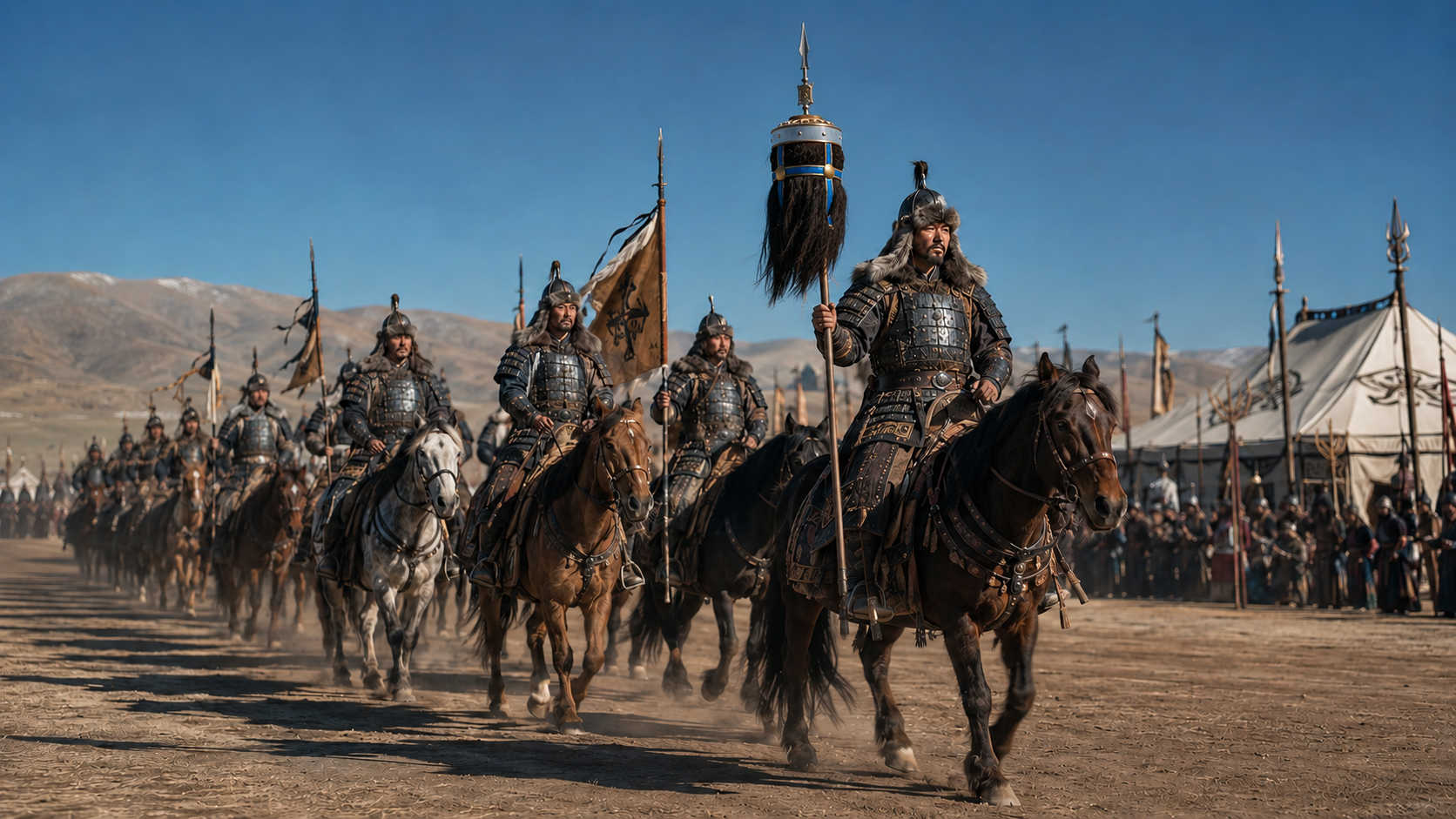
Modun Shanyu became the supreme ruler of the Xiongnu, establishing the first great empire of Mongolia and Central Asia. He defeated the Han Dynasty of China and boldly defended Mongolian territory — the first great unifier.
The founding of Mongolia's first centralized state — the era that defined the grand strategy of the nomads.
6–8c
The Turkic Khaganate & the Uyghurs
The Turkic Khaganate rose to power across Central Asia, expanding the linguistic and cultural framework of the Mongolian peoples. The Uyghur state that followed introduced a writing system and elevated cross-steppe connections to a new level.
These empires were the precursor to Chinggis Khan's unification — laying the groundwork for Mongol consolidation.
1206
Foundation of the Great Mongol Nation
Temüjin was proclaimed Chinggis Khan at the Great Khurultai of 1206, uniting all Mongolian clans and tribes under one banner. The greatest turning point in Mongolian history.
The Khurultai's decree unified nomadic society at a political level, laying the foundation of a single sovereign state.
1211
Expansion of the Great Empire
Under Chinggis, Ögedei, and Khubilai, the Mongols united vast stretches of Asia and Europe, creating the Pax Mongolica — the Mongol Peace. The world's trade routes were unified for the first time.
The Mongols built the most powerful empire the world had seen, enabling remarkable cross-cultural exchange across ancient civilizations.
1271
The Yuan Dynasty
Khubilai Khan founded the Yuan Dynasty and ruled China, but in 1368 a Han rebellion ended Mongol authority. Sub-khanates — the Golden Horde, the Ilkhanate, and others — spread across Eurasia.
The fall of the Yuan Dynasty marked a new direction for the Mongol state and its successor kingdoms.
1691
The Khalkha–Manchu Alliance
The four Khalkha banners entered a treaty with the Manchu Qing Dynasty, establishing military cooperation and religious ties. For the Mongols, this was primarily a protective alliance against western threats.
The influence of this era would shape the future path of Mongolian independence for generations to come.
1911
The Independence Revolution
Mongolia broke free from Manchu-Chinese rule and proclaimed the Bogd Khanate of Mongolia. In 1921, the People's Revolution succeeded under the leadership of Sükhbaatar.
The dawn of modern independence — an era that defined the new form of Mongolian statehood.
1924
The Mongolian People's Republic
The Mongolian People's Republic was established, building social infrastructure, education, healthcare, and railways across the country. In 1945, Mongolia joined the United Nations.
The beginning of Mongolia's modern education system and formal international relations.
1990
Democracy & New Values
A peaceful revolution brought sweeping social change; through a multi-party parliament, democratic governance was newly established. Private ownership and freedom of the press were opened to all.
1990 — the year that cemented the modern values of the Mongolian people.
2006
Modern Development
Mongolia partnered with the IMF and World Bank to strengthen economic stability, with mining and cultural tourism sectors recording significant growth throughout the decade.
Renewable energy, digital infrastructure projects, and urban complexes expanded rapidly across the country.
2026
Chinggis Khaan International Festival
2026 — the year of Mongolia's cultural and digital renaissance. The Chinggis Khaan International Festival is set to become the grand stage through which Mongolian history, art, and heritage are presented to the world.
A moment that bears witness to the connection between Mongolia's past, present, and future.